August 1, 2026
Plaud Now Connects to ChatGPT and Claude. Here Is What It Changes.
The short version: on July 28, 2026, Plaud announced integrations that connect ChatGPT and Claude to your Plaud account, so an assistant can pull up your recordings and read their transcripts on request. It is a real convenience and worth turning on if you already use one of those assistants. What it does not do is change what transcription costs you, and that is worth understanding precisely rather than roughly.
What Plaud shipped
Per Plaud's announcement of July 28, 2026, the integration is built on MCP, the Model Context Protocol, an open standard for connecting assistants to outside data. In practice:
- It works with Claude on web and desktop, and with ChatGPT.
- It also works with MCP-capable developer tools, with Claude Code, Cursor, Windsurf, VS Code, Zed and Codex named in the announcement.
- For ChatGPT Web and Claude Web, setup is a guided authorization inside the interface. Claude Desktop, Claude Code and the developer tools run an installer instead. No API keys and no code either way.
- As of August 1, 2026, Plaud's pricing page lists the Plaud MCP Server (Beta) among the features of every plan, including the free Starter. The AI client you connect may have plan or usage requirements of its own.
- The examples Plaud gives are workplace ones: updating a CRM after a call, cross-referencing a recording against another system, and spotting tasks that were agreed in a meeting but never reached a tracker.
Why this is a real improvement
Worth saying plainly, because the rest of this post is about precision: this closes a genuine gap. For the direct, on-demand workflow, bringing a Plaud transcript into ChatGPT or Claude generally meant exporting or copying text by hand. Plaud already supported automated routing through Zapier, but the new connector lets the assistant find recordings itself and read across several of them in one question. If your work looks like "what did we actually agree across those four calls", that is a meaningfully better day.
If you use ChatGPT or Claude and you are comfortably inside your plan's minutes, turn it on. Nothing in this post argues otherwise.
What the connector can actually do
Per Plaud's MCP documentation (read August 1, 2026), the server exposes a small, readable set of tools:
| Tool | What it does |
|---|---|
login / logout |
Signs you in through your browser, or revokes access |
get_current_user |
Reads your account details |
list_files |
Lists your recordings, with filtering |
get_file |
Returns a recording's details, including a temporary audio download URL valid for 24 hours |
get_note |
Fetches the AI-generated summary, action items and key topics |
get_transcript |
Fetches the full transcript with timestamps and speaker labels |
Now read that list again with one question in mind: which of these makes a transcript exist? None of them. There is no documented tool that starts a Plaud transcription, and none that adds minutes to your plan.
That is a narrower claim than "the assistant can't see the recordings you never transcribed", and the narrower version is the true one. It can list the recording. What it cannot do is produce a Plaud transcript that isn't there yet.
Where the minutes are spent
Transcription, the step where audio becomes text, is what your plan meters. Plaud's Starter tier includes 300 transcription minutes a month and Pro includes 1,200; Unlimited removes the monthly minute cap, subject to Plaud's currently listed limit of up to 24 hours of transcription per day (Plaud plan limits, August 1, 2026). Those numbers govern step 2 below. The connector operates at step 3.
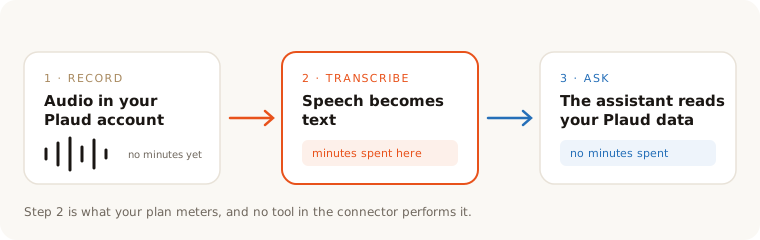
Three consequences follow:
- Listing is not transcribing. A recording you never transcribed can still turn up when the assistant lists your files. There is simply no Plaud transcript for
get_transcriptto return, and nothing in the toolset creates one. - The allowance did not change. Monthly minutes still reset at the end of each billing cycle and unused ones do not carry over. Extra Minutes packs still carry their activation and validity windows (Plaud support pages, July 2026).
- More useful transcripts may increase how many recordings you choose to transcribe. That does not change the allowance. It may simply make transcription more valuable to you than it was last month.
None of that is a flaw. It is a description of which problem the integration solves. It solves "the text is awkward to get to". It does not solve "the text is expensive to make".
Who feels the difference, and who doesn't
You will love it and find this post pedantic if you transcribe comfortably within your allowance. The friction you had is gone, and the meter was never what bothered you. Good.
You will notice that the allowance did not change if the monthly minute count was your actual constraint. The connector improves access to your Plaud data; it does not add transcription minutes to your plan.
What to check on your own account
Two numbers settle which group you are in:
- Minutes you actually used last month, in the Plaud app. Not what you pay for: what you spent.
- Hours of audio you have never transcribed. That backlog is the honest measure of whether minutes are your constraint.
If the first is well under your allowance and the second is near zero, minutes are not your problem and you can stop reading. If the second is in double digits, the integration is a nice quality-of-life win sitting on top of a constraint that is still exactly where it was.
If the minutes are the part that hurts
Then the question is not which assistant reads the text. It is what the text costs to produce.
Scribefy is an independent transcription service for the recordings in your own Plaud account. You connect the account once, pick which recordings to transcribe, and see each recording's length before deciding; nothing is spent until you click. The first 300 minutes each month are free, and past that a $6.50 pack covers 600 minutes with no expiration date (Scribefy pricing, July 2026). Every transcript exports as TXT, SRT or Markdown, ready to paste into the same ChatGPT or Claude you just connected.
One trade-off we should name, since this whole post is about being precise: transcripts made with Scribefy live in Scribefy, not in your Plaud account. Plaud's connector reads Plaud's data, so it will not see them. Getting them into an assistant is the export-and-paste route, which our Plaud to ChatGPT walkthrough covers with prompts included. That is a genuine difference in convenience, and you should weigh it against the difference in what the minutes cost. Some people will decide the one-click route is worth the price, and that is a reasonable call. We would just rather you make it holding both facts instead of one.
The one-minute version
Plaud's ChatGPT and Claude integration (July 28, 2026) is a good, free convenience for the transcripts in your account. Its documented tools read your recordings, notes and transcripts; none of them starts a transcription or adds minutes. If your recordings mostly sit untranscribed because the minutes ran out, this is not the thing that was standing in your way.
Scribefy is an independent service. Not affiliated with, endorsed by, or sponsored by Plaud. ChatGPT, Claude and other products are trademarks of their respective owners, named here only to describe what the integration connects to.
Related questions
Does Plaud's ChatGPT integration transcribe my recordings?
No. Per Plaud’s MCP documentation (August 2026), the connector’s tools cover signing in, reading your account, listing recordings, fetching a recording’s details, and retrieving its note and transcript. None of them starts a transcription, and none adds minutes to your plan. Transcription is the separate, earlier step that your plan meters.
Does asking ChatGPT about a meeting spend my Plaud minutes?
Reading data that already exists is not transcription, so it does not spend transcription minutes. The AI tool you connect may have usage limits or pricing of its own. What spends minutes is turning audio into text in the first place.
Do I need a paid Plaud plan to use the MCP integration?
No paid Plaud membership is currently listed as required. As of August 1, 2026, Plaud’s pricing page lists the Plaud MCP Server (Beta) among the features of every plan, including the free Starter. The AI client you connect may have separate plan or usage requirements of its own.
Will it see transcripts I made with another service?
No. Plaud’s connector reads data in your Plaud account. A transcript produced by an independent service lives in that service, so you move it into an assistant by exporting the text and pasting it. That is a real difference in convenience, and worth weighing against what the minutes cost you.
Scribefy is an independent service. Not affiliated with, endorsed by, or sponsored by Plaud.