Guide · updated August 2, 2026
How to Use Plaud Without a Subscription
You don't need a monthly plan to turn Plaud recordings into text. There are three realistic routes: stay inside Plaud's free Starter tier, export your audio and transcribe it wherever you like, or connect a pay-per-use service that transcribes on demand. Which one fits depends on how much you record and how much manual work you'll tolerate.
Here's each route with its honest trade-offs.
Route 1: Plaud's free Starter tier (official, $0)
Every Plaud account includes 300 transcription minutes per month at no charge. No subscription, no card. If you record five hours a month or less, this is the answer and you can stop reading.
The limits to know:
- The 300 minutes reset monthly and unused minutes don't accumulate.
- Minutes are spent when a recording is transcribed, not when it's recorded.
- Once you hit zero, new transcriptions pause until the next reset. Recording and syncing continue normally.
If your volume only occasionally spikes past 300 minutes, pairing Starter with one of the routes below just for the overflow is a perfectly sane setup.
Route 2: export the audio, transcribe it anywhere
Your recordings are yours, and Plaud gives you official ways to get the audio out:
- The Plaud app. Open a recording and use the export option to save the audio file (MP3 or WAV). Transcript exports (TXT, SRT, DOCX, PDF) are also available, but only for recordings that have already been transcribed, which means minutes were already spent on them. Audio export itself doesn't cost minutes. It's manual and per file, so it works best for a handful of recordings rather than a backlog.
- The official Plaud CLI. Plaud publishes a free command-line tool that lists your recordings and generates download links for the original audio. Downloading audio doesn't spend transcription minutes. It runs in a terminal, so it suits technical users comfortable with a shell.
Once the audio is on your machine, any transcription tool you already have will take it from there: a desktop app, a cloud service you already pay for, even the dictation features built into some office suites. The trade-off is the labor. You become the pipeline, file by file: download, upload, name the file, store the result somewhere. Speaker labels and summaries depend on whatever tool you chose, and nothing links the transcript back to the recording in your Plaud library. Our export guide walks through both official paths step by step.
Route 3: on-demand transcription, pay per use
The third route is a service that connects to your Plaud account and transcribes only what you ask for. This is what Scribefy does, and it was built precisely for people who don't want a subscription:
- 300 free minutes every month, no card required.
- Packs instead of plans. Beyond the free minutes, you buy one-time packs: $6.50 for 600 minutes, $30 for 3,000, $50 for 6,000. They never expire. For comparison, Plaud's own 600-minute pack is $12.99 (Plaud list prices, June 2026).
- Nothing is spent until you click. Each recording shows its length up front, and no minutes move until you choose to transcribe it. Re-transcribing a file is free.
- Your whole library is reachable. Any recording in your Plaud account can be transcribed, old or new, with speaker labels, AI notes and chat included.
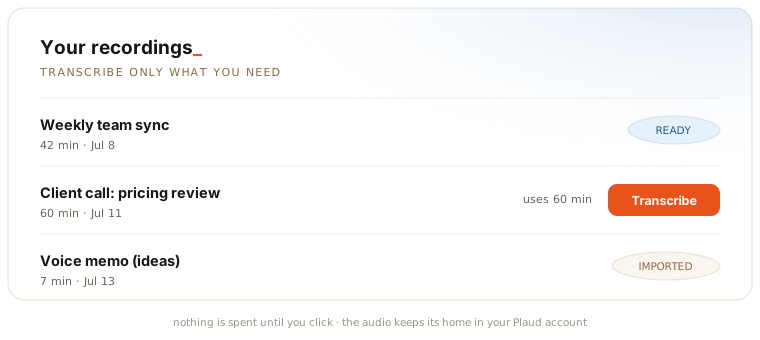
Setup takes about a minute: a small helper (~2 MB) runs on your machine, you log in to Plaud there, and your recordings appear. The audio keeps its home in your Plaud account, and a file is only read when you ask for its transcription.
What about the ChatGPT and Claude connector?
Since July 28, 2026, Plaud ships an official MCP connector that lets ChatGPT, Claude and other MCP-capable tools reach your Plaud account, and it is listed on every plan including the free Starter tier. It is genuinely useful, and it is worth being precise about what it changes here, because it does not change the thing this page is about.
None of its documented tools starts a transcription. It can list your recordings and retrieve a recording's details, its notes and its transcript — and it can return a temporary download link for the original audio. What it cannot do is make a transcript exist that isn't there yet. Ask it about a recording you never transcribed and there is no text for it to fetch.
So the connector is a way to work with transcripts you already have, not a way to obtain them. If your question is "how do I get my recordings turned into text without a monthly plan", the routes above are still the answer. If your question is "how do I get the text I already have into my AI tool", the connector is the official path and it is free. We wrote up what the connector actually does in more detail.
One honest footnote, since it cuts against us: because the connector reads your Plaud account, it sees transcripts that live in Plaud. Transcripts made elsewhere, ours included, live where they were made.
Mixing routes is allowed
These aren't exclusive choices. A pattern that works well: use Plaud's free 300 minutes for quick daily captures, keep Scribefy connected for the overflow and for older recordings you want back as text, and export audio manually only for the rare file you need to hand to someone else. Since Scribefy also has a free monthly tier, a light user can run both free tiers side by side and pay nobody at all.
Which route should you pick?
Prices below are Plaud list prices and Scribefy pricing as of June 2026:
| Route | Cost | Effort | Best for |
|---|---|---|---|
| Starter tier | $0 | None | Under 300 min/month |
| Export + DIY | $0 plus your tools | High, per file | Technical users, few files |
| On demand (Scribefy) | 300 min free, then $6.50/600 min | Connect once | Variable volume, no plan wanted |
The honest summary: light users never need to pay anyone. Heavy manual types can own the whole pipeline through official exports. And if you want transcription that simply waits for you, with no monthly meter running, pay-per-use packs exist so that a subscription stays a choice rather than a requirement.
Fair questions, straight answers
Can I transcribe Plaud recordings for free?
Yes, two ways. Plaud's own Starter tier includes 300 free transcription minutes each month, and Scribefy also gives you 300 free minutes every month after you connect your Plaud account (both as of June 2026). The quotas reset monthly and neither requires a paid plan, so you can even stack them.
Do I need a Plaud subscription to use Scribefy?
No. Scribefy works with any Plaud account, including the free Starter tier. You connect once and transcribe on demand, paying only for what you transcribe beyond your free monthly minutes.
What happens to my audio when Scribefy transcribes it?
Your audio keeps its home in your Plaud account. A file is only read when you ask for its transcription, and nothing is spent until you choose to transcribe a recording.
Does the new ChatGPT and Claude connector let me skip paying for transcription?
No, and it is worth knowing why before you count on it. Plaud's official MCP connector (live since July 28, 2026, and listed on every plan including free Starter) lets AI tools list your recordings and retrieve their details, notes and transcripts, and it can return a temporary download link for the original audio. But none of its documented tools starts a transcription. It works with text that already exists, so it is excellent for using transcripts you have and does not produce transcripts you don't.
Do pay-per-use minutes expire?
Scribefy packs never expire. You buy a block of minutes once (600 minutes for $6.50, for example) and the balance waits until you use it. There is no monthly reset and no activation deadline.
Scribefy is an independent service. Not affiliated with, endorsed by, or sponsored by Plaud.